How to deploy VPUs with confidence through real data, proven architectures and radical technical transparency.
Overview
Architectures
Explore
Test
Migrate
Scale
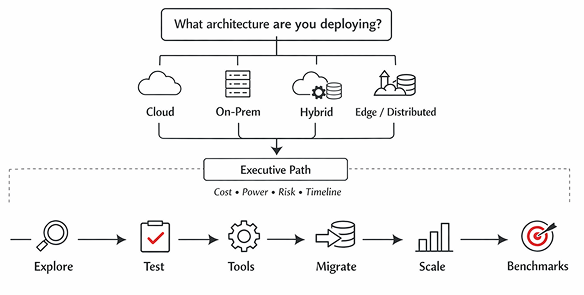
This playbook guides engineers from their current encoding architecture, to a scalable VPU deployment.
Start with your current encoding environment and the constraints shaping your infrastructure.
Encoding runs entirely inside public cloud compute environments.
Typical Pain Point: Runaway compute costs.
Likely Path: Repatriate heavy encoding workloads to VPU servers to cut costs.
Encoding runs in infrastructure you own and operate.
Typical Pain Point: Density and power limits.
Likely Path: Replace inefficient CPU racks with high-density VPU servers.
Encoding runs across both your infrastructure and public cloud.
Typical Pain Point: Workload orchestration complexity.
Likely Path: Run baseline workloads on VPUs and burst to cloud only when necessary.
Encoding runs across many regional locations close to viewers.
Typical Pain Point: Hardware footprint limits and operational scale.
Likely Path: Deploy compact VPU nodes at POP locations closer to users.
Determine your migration strategy where VPU encoding should run to deliver the best performance and economics.
VPU Cloud encoding:
On-Prem VPU encoding:
Hybrid encoding:
Edge encoding:
Quadra Video ServerIdeal for large-scale transcoding deployments requiring maximum stream density.
Quadra Mini Server Ideal for edge deployments, labs, and smaller production spaces.
T1MOEM embedded system. Ideal for small space or edge deploymentsForm factor: M.2 Fits Quadra Mini Server
T1UGeneral-purpose for data center encoding. Form factor: U.2.Fits ALL Quadra Servers
T1AIdeal for power or thermal constrained deployments.Form factor: AICFits 1RU Quadra Video Server
T2ADual-chip for 2X power. Ideal for maximum density and lowest cost-per-stream.Form factor: AICFits 1RU Quadra Video Server
Confirm that your encoding pipeline, software stack, and Ecosystem partners work together seamlessly.
VPU Ecosystem Directory
Leverage our Ecosystem partners
Launch production VPU infrastructure with the tools to monitor, automate, and grow.
This includes:
Areaworkflow automationperformance monitoringhardware health stream management
ToolsBitstreamsBitstreams dashboard VPU telemetry Orchestration software
Outcome: The architecture becomes a production system that scales.
Edge / Distributed architecture is next.